Meta whistleblower: Zuckerberg’s apology to families a ‘turning point’

WATCH INTERVIEW ON CNBC.COM

Meta whistleblower Frances Haugen felt co-founder and CEO Mark Zuckerberg’s testimony before Congress was “powerful” on Wednesday — especially when he turned to apologize directly to families who blamed the toxicity of social media for the loss of a loved one.

“That apology, I think, is a turning point because it’s the first time he’s actually had to visibly face the consequences of his choices,” Haugen said on CNBC’s Last Call.

The hearing regarding child safety on social media featured several prominent tech CEOs from Discord, Snap, TikTok, and X, the platform formerly known as Twitter. But perhaps none drew more ire from lawmakers than Zuckerberg.

At one point, Missouri Republican Sen. Josh Hawley pressed Zuckerberg on research that showed minors were encountering inappropriate and unwanted content like nudity on Instagram at an alarming rate. Zuckerberg fumbled and then refused to answer Hawley’s question over who was fired in the wake of those revelations.

“Do you know who’s sitting behind you,” Hawley asked. “You’ve got families from across the nation whose children are either severely harmed or gone. You don’t think it’s appropriate to talk about steps that you took?”

Hawley implored Zuckerberg to apologize to those in attendance, and the CEO rose from his seat and turned to speak directly to the crowd.

“I’m sorry for everything that you have all been through. It’s terrible,” Zuckerberg said. “This is why we invest so much and are going to continue doing industry-leading efforts to make sure that no one has to go through the types of things that your families have had to suffer.”

Haugen, the former Facebook product manager turned whistleblower who leaked a trove of internal documents to the Wall Street Journal in 2021, said the apology was amplified by the many families in attendance.

“It was a full room,” Haugen said. “The energy was electric.”

Many of the internal documents Haugen leaked detailed the company’s knowledge of the potentially harmful impact social media platforms Facebook and Instagram may have on underage users.

Clicks Over Clarity: Misleading Headlines About Tesla’s “Recall” 

Wednesday, December 15

Context: After a years-long investigation into Tesla’s autopilot feature, NHTSA has ordered the company to recall 2 million of its vehicles. But all this means for Tesla is that they’ll have to issue an over-the-air software update to adjust the feature at no cost to owners.

While we originally planned to have this discussion around Tesla’s stock price, our host Brian Sullivan quickly honed in on the detail that many publishers were burying or outright ignoring.

Brian: “I think for most consumers, when they see the word ‘recall’ they assume something more serious than a software update.”

We had passionate Tesla investor Ross Gerber join Last Call to share his take on the issue that seems to repeat itself every few months.

Ross: “I do think it’s very misleading when the media runs headlines like 2 million cars being recalled. It certainly infers that there’s a negative financial impact to this — and there isn’t,” Gerber said. “The media must call Tesla for comment — as you guys do every time — and what do they say: nothing.”

“Why would the headlines be correct? How would the headlines be correct if they don’t correct them? So now you have me on tv and we try to get the right information out to consumers, to viewers, and to investors. Tesla doesn’t do this. So why?”

While Gerber’s point about Tesla lacking a PR department to thwart false narratives about the company is justified, I would place the onus for this miscommunication on business journalists. Media has a responsibility to fact-check the initial headlines it receives from government agencies, not rely on dated language. Just look at some of these headlines:

Credit to the Financial Times and our own network CNBC for framing the story accurately. While other publications’ headlines were factually correct, there is a responsibility to not omit vital details that would better inform the casual reader.

Rightfully so, Tesla enthusiasts were pissed — and don’t just suspect a lack of due diligence from media — but believe the error occurs repeatedly because of a concerted effort to smear Tesla.

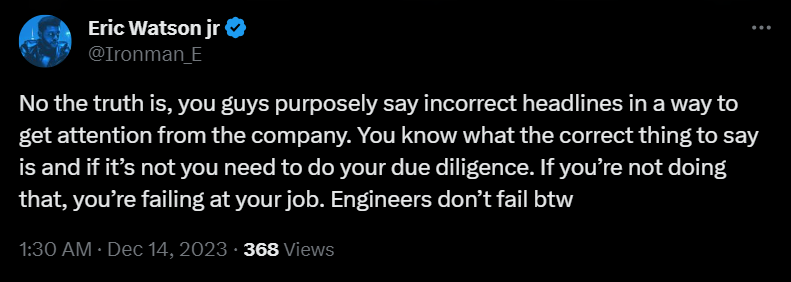
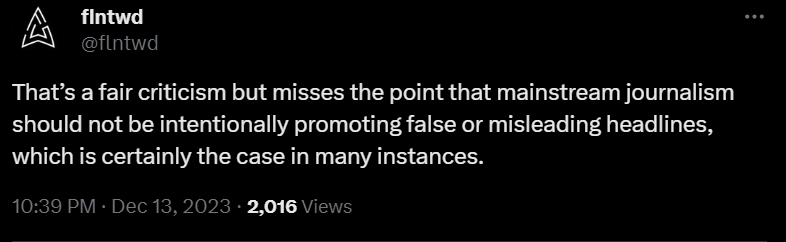
These were replies to the Last Call interview posted to twitter. There is a complete lack of trust in business journalism. Tesla supporters feel jaded and even resort to criticizing the network that is pointing out the misinformation in the media ecosystem.

This is the cost of a media that prioritizes clicks over clarity.

In the control room during this live interview, even I noticed that our first headline didn’t have enough room to mention the software update. You’ll notice at 0:54 we change the banner (that has limited character space) to “TESLA ROLLS OUT AUTOPILOT UPDATE”.

You’d like to think this online backlash from Tesla believers would cause journalists to think twice about their headlines. All I can say from my team is that it won’t be a mistake you see on Last Call.